

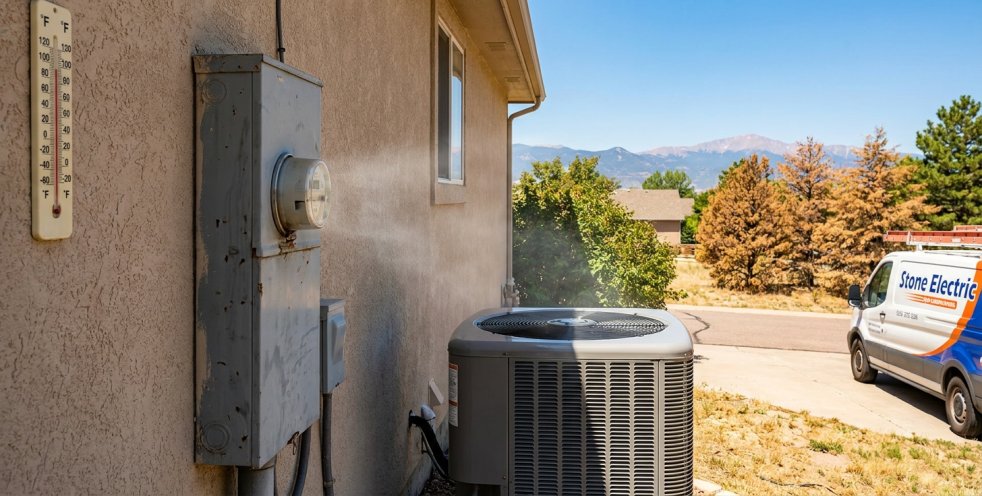
Why Your Electrical Panel Might Not Handle Summer AC and Peak Demand
Summers along the Front Range have been getting hotter. Greenwood Village regularly sees stretches of 95-plus-degree days, and that heat puts serious pressure on your home's electrical system. The problem is not always that your panel fails outright. Often, it just quietly struggles, and you don't notice until something goes wrong.
How Colorado's Rising Temperatures Change the Equation
Older homes in the Denver metro area were built when central air conditioning was either optional or undersized. Electrical panels from the 1970s, 80s, and even 90s were designed around a much lighter load than what modern households demand.
Today, a typical Greenwood Village home in summer might be running a central AC unit, a refrigerator, a chest freezer, an EV charger, multiple computers, and a pool pump, all at the same time. That combination can push a 100-amp panel well past its comfort zone.
Why "Still Works" Does Not Mean "Working Safely"
This is the part most homeowners miss. Your panel can be overloaded without tripping a single breaker. Breakers are rated to trip under sustained overload, but chronic near-capacity operation causes heat buildup, accelerated wear on wiring, and increased fire risk, all before anything visibly fails.
Think of it like driving a car engine at redline for hours. It may not blow up today, but the damage is accumulating.
Warning Signs Your Panel Is Struggling
Watch for these indicators, especially during hot weather when demand peaks:
-
Breakers that trip repeatedly, especially when the AC kicks on
-
Lights that dim or flicker when large appliances start up
-
A burning smell or warm spots near the panel
-
Buzzing or crackling sounds coming from the breaker box
-
Breakers that feel hot to the touch
-
A panel that still uses fuses instead of circuit breakers
Any one of these is a reason to have a licensed electrician take a look. More than one is urgent.
Common Causes of Panel Overload in Summer
Understanding what drives the problem helps you make smarter decisions about your home's electrical system.
-
Central AC units draw 15 to 60 amps, depending on size, and the startup surge is even higher
-
Older 100-amp panels were not designed for today's appliance loads
-
Adding an EV charger or hot tub without a panel upgrade is a common mistake
-
Double-tapped breakers (two wires on one breaker terminal) are a frequent code violation found in older homes
-
Ambient heat in summer raises the temperature inside the panel itself, reducing its efficiency
What You Should Do Next
If your home is more than 20 years old and you have not had an electrical inspection recently, this summer is a good time to schedule one. A licensed electrician can perform a load calculation to determine whether your current panel has the capacity for your actual usage.
Common solutions include:
-
Upgrading from a 100-amp to a 200-amp (or larger) service panel
-
Adding a subpanel to distribute the load more evenly
-
Installing dedicated circuits for high-draw appliances like AC units, EV chargers, or dryers
-
Replacing outdated breakers or addressing double-tapped wiring
These are not optional upgrades if your panel is already showing warning signs. They are safety measures.
Do Not Wait for a Failure to Act
Electrical panels do not usually give you a dramatic warning before a serious problem develops. By the time a breaker fails to trip during an overload, or wiring insulation has degraded from years of heat stress, the risk is already significant.
Stone Electric works with homeowners and businesses throughout Greenwood Village and the surrounding area to assess panel capacity, identify code issues, and handle upgrades the right way. If you have noticed any of the warning signs above, or just want peace of mind before the hottest months hit, give us a call at (720) 728-1936 to schedule an inspection.